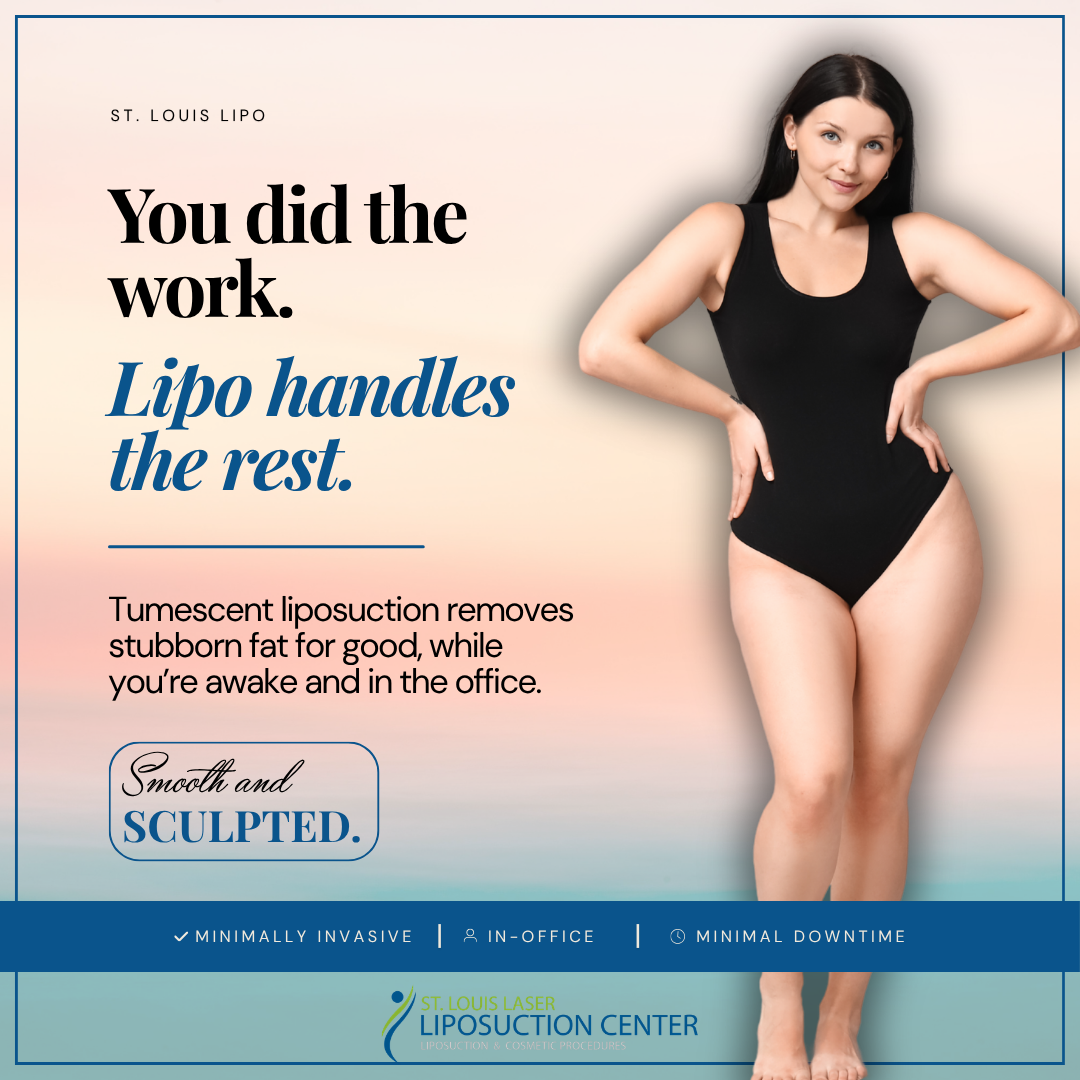
You eat well. You exercise. The scale has moved. And yet there it is: a pocket of fat on your lower belly, your flanks, your inner thighs, or under your chin that simply will not go away.
If that sounds familiar, you are not imagining it and you are not doing anything wrong. Stubborn fat is a real biological phenomenon, and it is the exact problem liposuction was designed to solve. This guide explains why some fat resists your best efforts, how modern liposuction works, and what patients in St. Louis and O’Fallon can expect from the process.
Why Some Fat Is So Stubborn
Fat cells are not distributed evenly, and they do not respond evenly to weight loss. Several factors explain why certain areas hold on.
Genetics decide where you store fat
Your body has a genetic blueprint for fat storage. For many women, that means hips, thighs, and lower abdomen. For many men, it is the belly and flanks. When you lose weight, your body draws from fat stores everywhere, but the areas with the highest concentration of storage-friendly cells lose last.
Fat cell receptors work against you
Fat cells carry two types of receptors that respond to hormones. One type promotes fat release, the other promotes storage. Stubborn areas tend to have more storage receptors and fewer release receptors, which makes them resistant to the signals that free up fat elsewhere.
The number of fat cells is largely fixed
By early adulthood, the number of fat cells in your body is mostly set. Weight loss shrinks those cells but does not remove them. This is why a pocket of fat can shrink, look smaller for a while, and then return the moment your habits slip.
Hormones and age
Menopause, thyroid changes, and cortisol from chronic stress can all shift where the body prefers to store fat. Many patients notice new stubborn areas in their forties and fifties that were never a problem before.
How Liposuction Works
Liposuction takes a different approach from diet and exercise. Rather than trying to shrink fat cells, it physically removes them.
The tumescent technique
At St. Louis Lipo, Dr. Wright uses tumescent liposuction, which is considered the standard for safe, in-office fat removal.
- Numbing solution is injected into the treatment area. This solution contains a local anesthetic and a medication that constricts blood vessels, which minimizes bleeding and bruising.
- The fat swells and firms up, which makes it easier to remove precisely and evenly.
- A thin tube called a cannula is inserted through small incisions and used to gently suction out fat cells.
- The area is contoured so the result looks smooth and natural rather than dented or uneven.
Because the procedure uses local anesthesia, patients are awake and comfortable, and the risks associated with general anesthesia are avoided.
Why removed fat stays gone
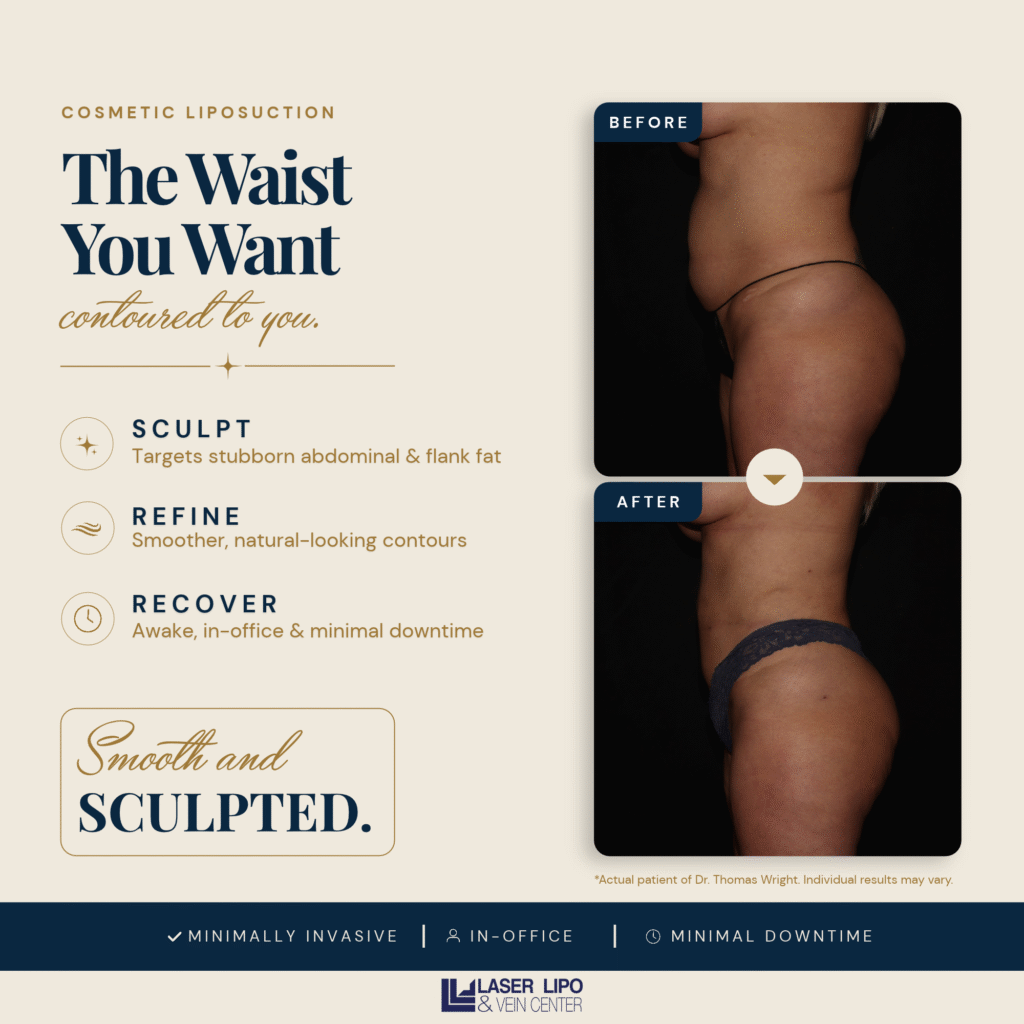
Since fat cells removed by liposuction do not grow back, the treated area has permanently fewer cells to store fat. If you gain weight in the future, the remaining cells can enlarge, but the treated area will typically stay proportionally smaller than it would have otherwise.
Common Areas Treated
- Abdomen and lower belly
- Flanks and love handles
- Inner and outer thighs
- Upper arms
- Chin and neck
- Back and bra line
- Knees
Many patients treat more than one area in a single session, which Dr. Wright will discuss based on your goals and the safe volume of fat that can be removed at once.
What Liposuction Is Not
Setting expectations honestly is part of good care.
- Liposuction is not a weight loss method. It is a body contouring procedure. The ideal candidate is already near a healthy, stable weight.
- It does not treat loose skin. If skin laxity is a concern, it can be addressed in the same session with Renuvion skin tightening, which is offered through our sister practice.
- It does not replace healthy habits. Results last when weight stays stable.
- It is not a treatment for lipedema on its own. Lipedema requires a specialized, lymph-sparing surgical approach that Dr. Wright provides through Lipedema Surgical Solutions.
Who Is a Good Candidate
You may be a good candidate for liposuction if you:
- Are within roughly 30 percent of your ideal weight and have been stable for several months
- Have specific areas of fat that have not responded to diet and exercise
- Have reasonably good skin elasticity
- Are in good general health and do not smoke
- Have realistic goals about proportion and contour rather than dramatic weight loss
Patients who have recently completed a medical weight loss program often find they are excellent candidates once their weight has stabilized. If you are unsure, a consultation will give you a clear answer.
What to Expect During Recovery
Recovery from tumescent liposuction is generally faster than many patients expect.
- First few days: Mild soreness, similar to a hard workout. Some drainage of the numbing fluid is normal. A compression garment is worn to reduce swelling.
- First week: Most patients return to desk work within two to three days. Walking is encouraged to support circulation.
- Two to four weeks: Swelling continues to decrease. Light exercise can usually resume.
- Three to six months: Final contours become visible as residual swelling resolves and skin settles.
Bruising and swelling vary by person and by area treated. Dr. Wright and our team will give you specific aftercare instructions tailored to your procedure.
Safety and Experience Matter
Liposuction is one of the most commonly performed cosmetic procedures, and when performed by an experienced physician using appropriate technique, it has a strong safety record. Outcomes depend heavily on the surgeon’s skill in removing fat evenly and preserving natural contours.
Dr. Thomas F. Wright is a board-certified physician with more than 25 years of experience in minimally invasive procedures. He has performed thousands of tumescent liposuction procedures at his O’Fallon and St. Louis offices and is a published researcher on surgical fat removal. Patients across Missouri and the Midwest choose St. Louis Lipo for that depth of experience.
Take the First Step
Stubborn fat does not have to be permanent. If you have done the work and still have areas that will not respond, liposuction can help you achieve the contour you have earned.
Schedule a consultation at St. Louis Lipo in O’Fallon or St. Louis to find out whether liposuction is right for you and which areas can be treated. You can also explore our procedure pages to learn more about specific treatment areas.